Smart output rails
IQ Slats
Unlike conventional passive slats, IQ Slats provide per-connection continuity visibility, angle awareness, and real-time field status — so you know exactly what's ready before you arm.
Before / After
Without IQ Slats
A cue shows a continuity problem. The crew still has to walk the rack and find which igniter or branch is bad.
With IQ Slats
The system identifies the specific connection that needs attention — before arming, with the crew still at the firing position.
Three variants — same ceiling, different shape
All three IQ Slat variants deliver the same 108 outputs per slat and the same 1,296-output ceiling across a full Connect 12 system. The only difference is how those outputs are organized into banks — choose the variant that matches how you fire, not a tradeoff in total capacity.
| Variant | Banks | Outputs / bank | Outputs / slat | System total (12 slats) | Best for |
|---|---|---|---|---|---|
| IQ Slat 9 | 9 | 12 | 108 | 1,296 | Fan racks, multi-shell sequences — more outputs per bank for complex per-position setups |
| IQ Slat 18 | 18 | 6 | 108 | 1,296 | 18-position directional racks — a middle ground between flexibility and density |
| IQ Slat 36 | 36 | 3 | 108 | 1,296 | Large single-tube mortar racks — one slat, one cable, maximum bank density |
Mix variants freely across Connect 12's ports — each is auto-detected. Every configuration reaches the same 1,296-output system ceiling; the variant you choose determines bank granularity, not total capacity.
Original variant
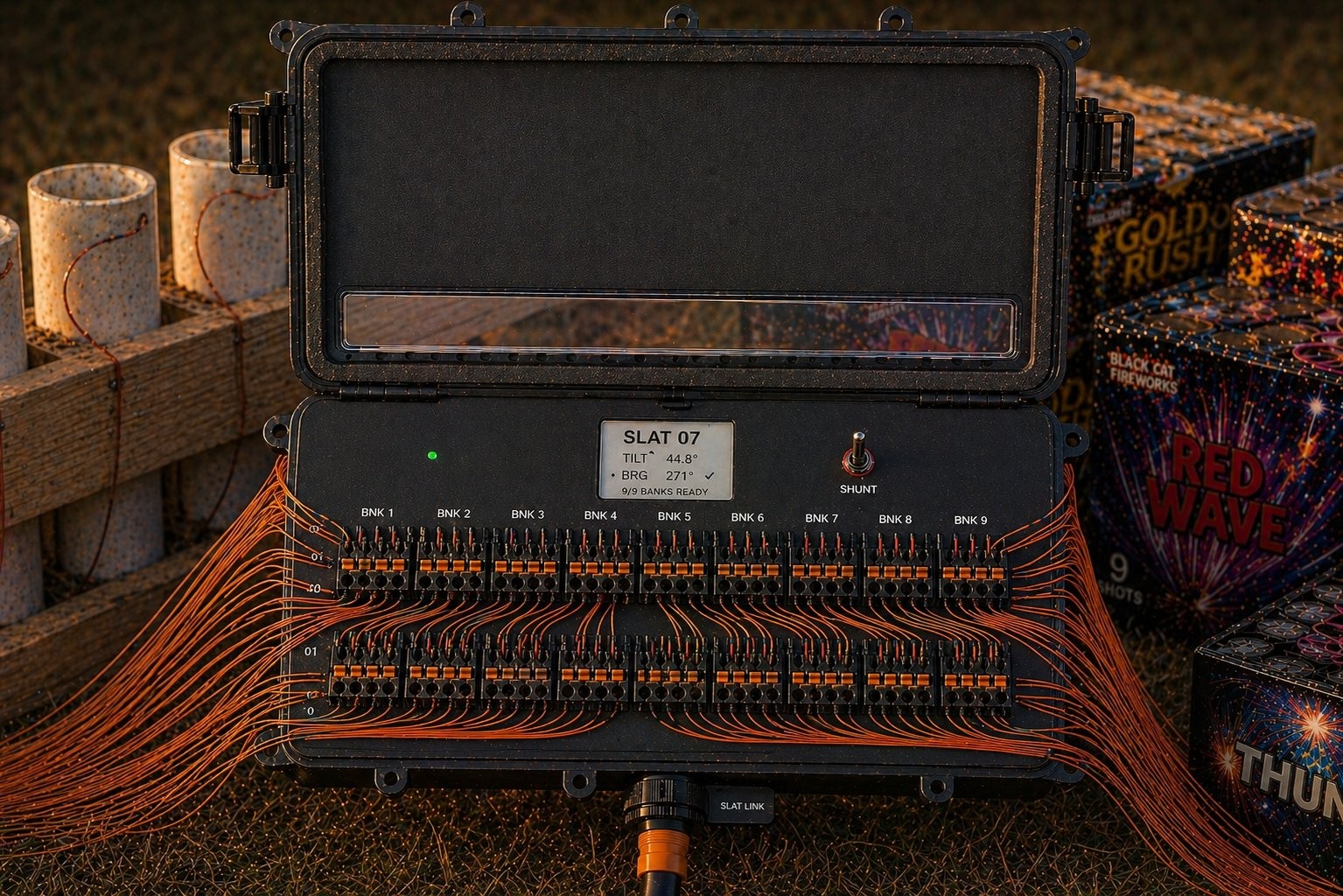
IQ Slat 9
9 banks of 12 outputs each — 108 outputs per slat. The right choice when you need more outputs per bank: fan racks, multi-shell sequences, and setups where a single cue triggers multiple products across a position.
- 9 banks × 12 outputs = 108 connections per slat
- 12 outputs per bank — fan out across multiple products
- Ideal for complex sequencing and multi-shell fan setups
Expanded variant
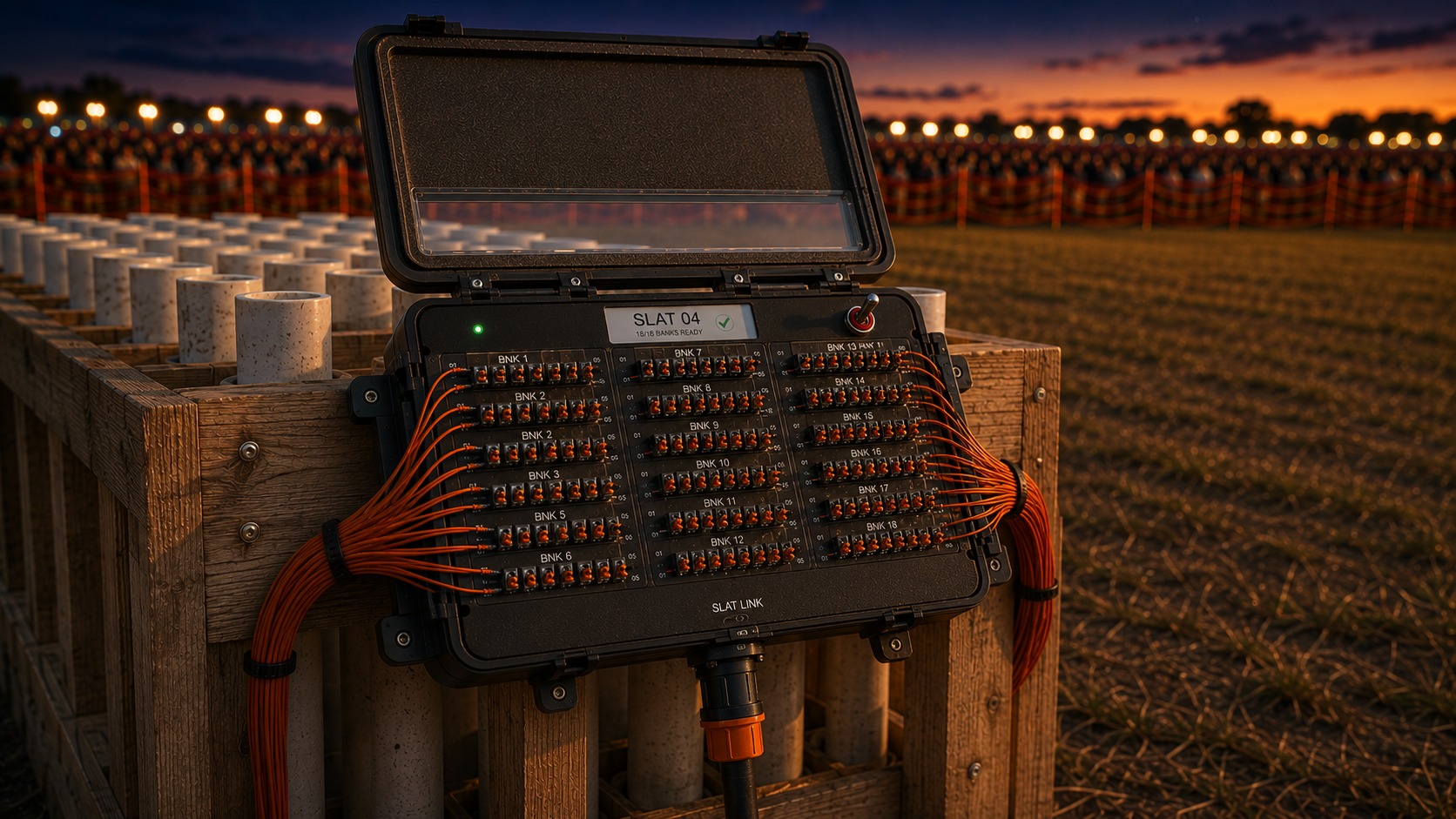
IQ Slat 18
18 banks of 6 outputs each — 108 outputs per slat, the same total as every other variant, spread across twice as many banks as IQ Slat 9. The right choice for 18-position directional racks where each bank addresses a specific direction or angle.
- 18 banks × 6 outputs = 108 connections per slat
- 6 outputs per bank — a middle ground between flexibility and density
- Same single Smart Slat Link cable — no wiring changes from IQ Slat 9
- Ideal for 18-position directional or cake racks
High-density variant
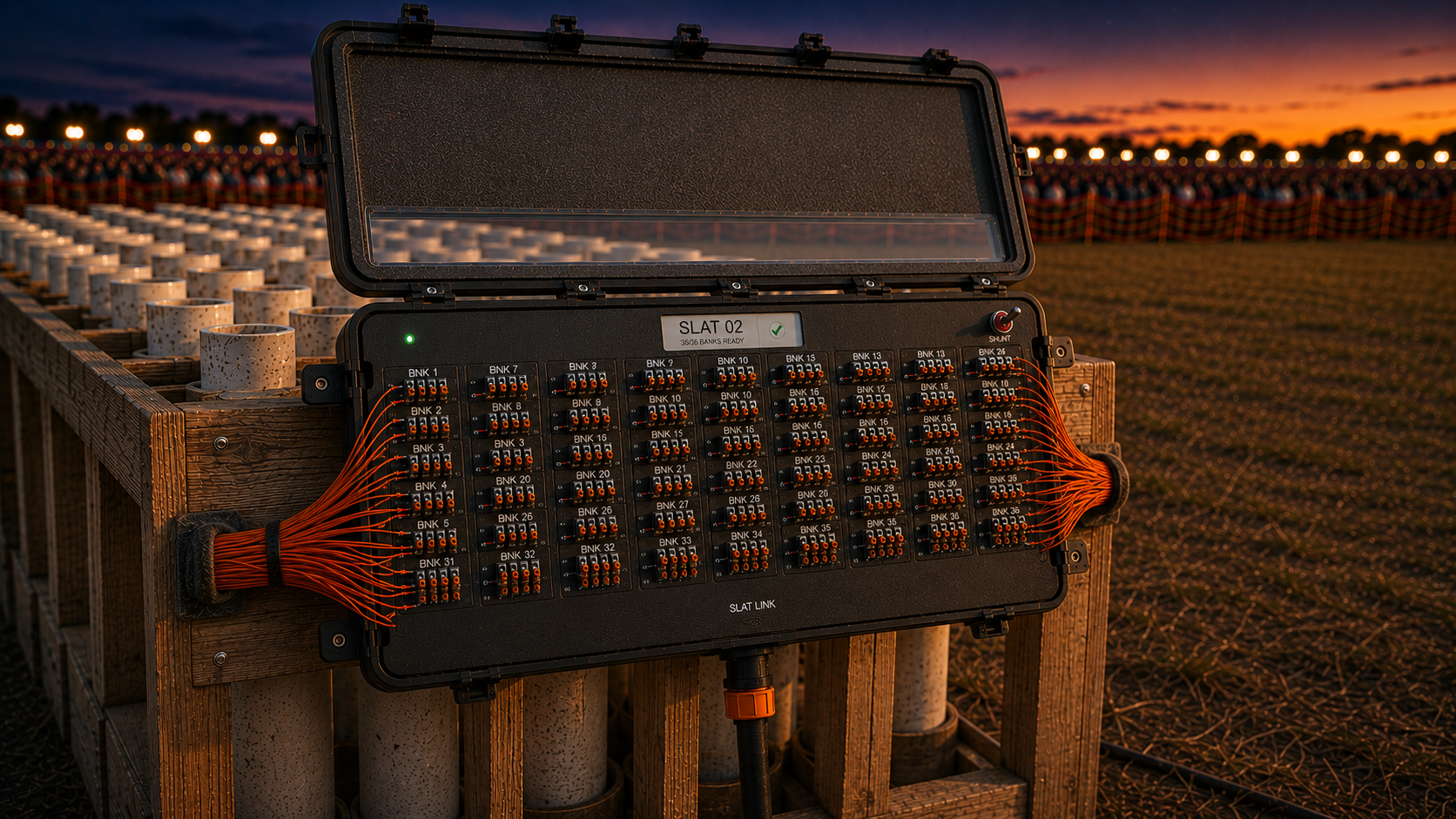
IQ Slat 36
36 banks of 3 outputs each — 108 outputs per slat, one slat covering an entire 36-position mortar rack from a single cable. The right choice for large mortar racks where each bank addresses a single tube position.
- 36 banks × 3 outputs = 108 connections per slat
- 3 outputs per bank — perfect for single-tube mortar positions
- One slat covers an entire 36-tube rack from a single cable
- Maximum bank density — same 1,296-output system ceiling as every variant
- Same single Smart Slat Link cable — no wiring changes from IQ Slat 9
Features common to all variants
Per-connection continuity
Continuity is measured at every individual connection — not just per cue. Before you arm, you see exactly which connection needs attention. Continuity current stays well under the NFPA 1126 25mA limit, sourced from a fully isolated power domain. See the compliance mapping →
Fully wired, fully shunted, until you say so
With the shunt engaged, every output on the slat is hardware-shorted — physically disconnected from the firing circuit, not just powered down. Igniters can be fully wired in, and rack prep can happen on your schedule. When you're ready to arm, connect the bulk cable and flip the shunt off. Always follow your standard site safety and AHJ-approved procedures.
Knock detection
If a CATO or other event knocks a rack over mid-show, IQ Slat doesn't wait for someone to notice. It detects the impact and disables that position automatically — so the rest of the show continues safely, instead of firing into a compromised rack or stopping the whole display.
Confirms your angle before you arm
Every IQ Slat has a built-in angle sensor. During setup, it confirms your rack is level — or at the exact angle your show calls for — so a rack that got bumped or set up wrong doesn't surprise you once the show starts.
E-Ink status display
Each IQ Slat's E-Ink display shows its assigned position number, set during show configuration. Because E-Ink holds its image with no power at all, that assignment travels with the slat — pick one up in the field and know exactly where it goes, no guesswork, nothing to power on to check.
No battery required
All power comes through the Smart Slat Link cable from Connect. Nothing to charge or replace at the rack.
Auto-detected by Connect
Connect 12 identifies each slat variant at startup. Mix IQ Slat 9, 18, and 36 freely — Connect maps banks automatically.
Built for the outdoors
Fireworks get shot outdoors — rain, snow, dust, whatever the day brings. IQ Slat is built to handle all of it without missing a beat.
Designed for the risk
IQ Slats sit closer to the product than anything else in the system — the highest-risk position on the firing line. That's exactly why they're built simple on purpose: no battery, no routing logic, no complex control. All of that lives in Connect, positioned further from the risk. IQ Slats carry exactly what they need at the rack — angle sensing, per-pin continuity monitoring, a sealed rugged enclosure — at a fraction of the cost of a firing module. If something takes one out, you've lost the simplest, least expensive part of your system, by design, not by chance.
Development status
IQ Slat V1 is in testing. V1.2 is in design, incorporating results from V1 validation. Contact us to discuss early access and pilot testing.